Tuesday, April 24, 2012

Conventions and Art: Mistakes, Mysteries and Misnomers. Part 1.

con•ven•tion   (k n-v n sh n) n.
1. a. A formal meeting of members, representatives, or delegates, as of a political party, fraternal society, profession, or industry.
b. The body of persons attending such an assembly: called the convention to order.
2. An agreement between states, sides, or military forces, especially an international agreement dealing with a specific subject, such as the treatment of prisoners of war.
3. General agreement on or acceptance of certain practices or attitudes: By convention, north is at the top of most maps.
4. A practice or procedure widely observed in a group, especially to facilitate social interaction; a custom: the convention of shaking hands.
5. A widely used and accepted device or technique, as in drama, literature, or painting: the theatrical convention of the aside.


The above description of convention is from the free online dictionary and leaves much to be desired when coming to an understanding of a convention.  While some conventions are customary and most customs, conventional there is a very distinct difference between the two.  They are not synonymous.  Conventions presuppose the applications of language.  A convention is a description; it is how we describe the world.  In effect all conventions are language conventions.  The shaking of hands is not a convention, it is a custom.  The convention is something like the description ‘this is a gesture of good will’.  Of course if we are shaking our hands at someone we may describe it as saying ‘goodbye’ or ‘hello’.  If our hand is a raised clenched fist that we are shaking we may describe the activity as ‘ranting’, all these descriptions are conventions.  Again the description is the convention and not the activity; the activity may or may not be customary.   I will demonstrate later why this distinction is important to the arts.

Items 1. a. & b. in the above definition are clearly different senses of the term convention but item 2. is a classic example of how a convention is understood.  We understand that prisoners of war are doomed to be treated in some way but a contract between nations describes what particular way they will be treated and this description (the convention) is what is applied to determine if the contract has been fulfilled.  Item 3. above is wrong; it is only by custom that north is at the top of most maps.  I’ve dealt with item 4. so I will attend to the role of convention in the arts.

One of the more common prosaic conventions is the describing of the movement of the earth as ‘the sun is setting’ or the ‘sun is rising’ (See Sorry, Earnest the Sun doesn’t Rise in this blog).  We know the sun doesn’t set or rise but, customarily, we invoke a convention; we describe it that way.  We could equally say the horizon was turning toward or away from the sun and be describing the same events.

One reason this distinction is important is that we are always free to create a new convention but the attempt to create a new custom is something of an oxymoron.  A custom in the sense we are discussing it is a habitual, commonly followed or traditional practice such as decorating a Christmas tree or walking on the kerb side of the pavement when escorting a guest. 


By definition a custom is not new but in the arts we often confront a new convention created to help us understand what it is we are viewing or listening to.  Indeed, often the first step in the evolution of a custom is the creation of a new convention. For the most part conventions in art are imperative; we must accept them in order to grasp the work.  Conventions provide us with a context which allows us to adjust our thinking about how a new aspect of our art-reality is to be understood.

In Nineteenth century theatre it was customary to open the curtain before the beginning of a performance.  The opening of the curtain prompted the description “The performance is beginning.”  In the theatre today it is not unusual that the dimming of the lights on the audience prompts the description that the play is beginning.   In many instances the set evoked the convention of place in a play though sometimes a description in the program provided an understanding of time and place such as; ‘Act I, Midnight, a country road.’

A convention entails an agreement to describe events in a particular way.  The agreement comes about by logical necessity and not because we choose to be condescending. In the game of chess we may doubt that the queen is a wanton hussy but if we do not acknowledge the convention that she is the most powerful piece on the board we will be limited in our ability to understand the game.  Just as an astronomer must describe the sun as setting to share our everyday understanding of the event, so too, must members of the audience describe the events of a stage play as real.  Macbeth is really killed though some may facetiously reply: “But the actor is not really killed!”  The retort is factitious because it is outside the bounds of the convention.  It is like saying: “The queen may be the most powerful piece on the board but she has a wooden head!”

Aeschylus, like many writers to follow, used the text to establish his convention of time and place as he does at the beginning of the AGAMEMNON.  The first actor to speak is a watchman.
 
 Oh God, for an end to this weary work.                                 
A year long I have watched here, head
on arm, crouched like a dog on Agamemnon’s
roof.  The stars of night have kept me company.
I know them all, and when they rise and set.
Those that bring winter’s cold and summer’s heat –
for they have power, those bright things in the sky.
And what I watch for is a beacon fire,
a flash of flame to bring the word from Troy,
word that the town has fallen.

The scene is set, though the play is performed in an open theatre in broad daylight, the audience must accept that the action begins at night at Agamemnon’s palace else what follows will make little sense.  The convention of time and place is imperative; it has been forced upon the audience.


I’ve used an example from theatre because the on-line dictionary uses the example of the aside promoting it as a convention.  But the aside is a custom; it is how it is described that is the convention.  An aside takes place when two or more characters are present on stage and one of them speaks to himself or the audience and the other characters are described as not hearing or not seeing the event.  The very nature of the aside requires that the other characters do not acknowledge it for to do so would provoke an entirely different order of events.  By the same token the audience must describe the other characters has having not heard or seen the aside taking place else their following responses will not be understandable.  In Euripides’ Hecuba the Trojan queen addresses herself in the presence of Agamemnon:

You poor wretch – I mean myself when I say ‘you’-
Hecuba, what am I to do?  Am I to fall at the
Knees of Agamemnon here or should I bear my
troubles in silence?


In this scene Agamemnon recognizes that Hecuba is wrapped in her own thoughts but he is not allowed to be described as hearing what she speaks though an audience of thousands hears it clearly.  Similar asides exist in Old and New comedy and are common in the works of Shakespeare and Nineteenth century Melodrama.  In each instance we must describe stage onlookers as not hearing else we have no way of explaining their failure to respond to the speaker of the aside.  The description is forced on us by the nature of the proceeding events which would be very questionable but for the convention we use.  The audience need not describe other characters confronted with an aside as hearing but not acknowledging the aside unless they demonstrate this is the case.

The quality of a work of art is a direct result of how we are obliged to describe it; the conventions we must use.      A few years ago some student actors staged a production of Joe Orton’s The Ruffian on the Stair. The play requires that one character menace another with a gun and eventually shoot him.  Surprisingly, the actor used what was clearly a toy cap pistol.  Though the weapon had much of the detail of an actual gun it was unmistakably a toy.  When questioned on this point, the students argued that the audience would accept the toy as actual.  They would describe the gun as real because that was how they understood it.  The students insisted that it was merely a convention and the audience would go along with it.  The students were wrong.  No doubt some sympathetic members of the audience may go along with such a corruption and say something to the effect: “Oh, I understand.  That toy cap pistol is supposed to be an actual gun” but this is not the way conventions work.  Conventions in theatre work by imperatives and imperative to the above example is that whatever else the audience may care to admit, it must admit that what it saw was not a gun.  The first rule of the theatre is ‘Don’t show the audience what you don’t want them to know, they can’t ignore it.’ 

The students were not satisfied.  They countered with the argument that most actors use a replica weapon on stage which was not an actual gun.  Why was this action correct and theirs faulty?  The students failed to grasp that, in the latter case, the audience had no information from the stage that allowed them to describe what was used as a replica.  The audience had no choice but to describe it as an actual gun.  Individually, some members of the audience may have suspected that what was being used was a replica which would not fire but this suspicion was not based on any information received from the production.  This was not the case with the student’s production.  They had, in fact, forced their audience to describe their instrument as ‘a toy gun’.  They had corrupted the convention they were trying to establish.

It is not unusual in comedies that authors and directors deliberately corrupt conventions for the purposes of satire.  In Mil Perrin’s light little comedy called The Flaw one character threatens to kill another with a cap pistol.  The victim replies: “But that’s a cap gun!” To this his assailant retorts: “So what?  This is only a play!”  The gun is fired and the victim falls to the floor in a manner that can only be described as ‘having been killed’.    The way the victim falls, clutching his chest, forces the description onto the audience who respond with laughter as they recognize the deliberate corruption of a convention.

When we wish to create new conventions in the theatre we must so organize events that a new description is forced onto the audience.  In Peter Shaffer’s Equus six horses dominate the stage and vivify the play but there are no actual horses used on stage (though this was not the case with the film).  The point is, the text requires that the horses be actual rather than imaginary.  The author recognizing the difficultly of using actual horses on stage forced a convention onto his audience.  Six adults wearing gleaming wire frames, each outlining the head of a horse, dressed in nondescript costumes and wearing raised shoes allowing them to sway and stamp in graceful equine movements obliged their audiences to describe them as horses.  It was a classic example of how theatre conventions work.  The play is about a seventeen year old boy’s psychological attachment to horses and would have failed had the technique of the dancer/actors, who portrayed the horses, shown a flaw and forced a
contrary description onto the audience.  The dancer/actors must camouflage their own personalities and shape and force the audience to project a description upon them. 

The audience needed no preparation to accept this convention.  If they wanted to participate in the theatre they had to oblige.  They could deny the convention only by showing it to be corrupt; by showing another convention that was imperative and negated the former; by showing how the actor/dancers gave themselves away as human figures through their lack of control.

All art forms and their works impose conventions on their audience, some prosaic and some very specialized.  In Part II we will discuss the visual arts and how conventions provide clues to how we understand particular works.

Launt Thompson

http://www.amazon.com/s/ref=nb_sb_noss?field-keywords=Launt+Thompson&url=search-alias%3Daps&x=16&y=9

Sunday, April 1, 2012

The Role of ‘Function’ and the Place of ‘Purpose’ in Art.


What is the ‘function’ of works we wish to call ‘art’?  It has been my experience that nearly everyone who actively involves themselves in one or more of our many art forms has a well formed answer to the above question.  Responses vary from “The function of art is to provide us with opportunities to reflect on some aspect of our or another’s society.” or “The function of art is to be pleasing.” to “The function of art is to serve human’s innate desire to create.”  (Some of you may wish to extend or change the wording in these examples to suit your own view.)  No doubt, most of us recognize that all of the above may be demonstrated by some works, but what may not be obvious is that by holding such views we are committing ourselves to setting the defining  criteria for what is to count as a work of art.                             
                                                       

There is an elephant in an Arizona Zoo (USA) which regularly appears before the public with its keeper, selects a brush with its trunk, chooses a colour from various dabs of paint on a palette and proceeds to brush colour onto a prepared canvas.  The process is repeated until a number of multi-coloured (dare I say) paintings are produced.  The zoo has placed many of these works on sale and the average price is $600 (US).  It may or may not be surprising to discover that the elephant is finding it taxing to keep up with the demand for these works.  I most certainly would buy one should I have the opportunity and I suspect we will see more zoo and circus entrepreneurs following suit once the genre has gained respectability.  But why stop with elephants when monkeys, brush tailed possums and spitting llamas are also candidates for exploitation?

                                                 Blue Flowers by 8 year old elephant Wanpen                                   

While many would purchase such works because they were a pleasing novelty my desire to purchase is mischievously motivated.  I own a number of what may be called abstract paintings and such a work would be a fitting addition for it would allow me to test the conviction of those who hold views similar to those above. I could, for instance, ask visitors to compare it to a work by a local artist which is often read as ‘a blood scared seal on an ice flow’ or a crow as road kill. 


The elephant piece would be described as pleasing but the latter has never received such praise.  Is one a candidate for a description as art and the other not merely because it does not (in the first instance) fulfill its function?   The elephant piece most surely does not serve ‘human’s innate desire to create’.  And we would not need to see such paintings to suggest that they provided ‘opportunities to reflect on some aspect of our or another’s culture’.  A verbal description would suffice for this activity and the paintings need never be shown.  And I am sure that some visitors would not be pleased to discover, after attentive analysis, that they had been duped by an elephant.   Can such pieces be disqualified as art on these grounds alone?  Might it be more probable that what has been described as the various ‘functions’ of art are not functions at all?

Kenneth Hudson describes ‘function’ as “One of the three most loved words of today’s industrial world.”[1]  He suggests that the term ‘function’ has been endowed with a ‘clown-like versatility’ which has served to promote much verbal nonsense which is a disease of those “...people with nothing to say, but with a powerful vested interest in saying it impressively.”[2]   Consequently academics, politicians, lawyers, management writers, theologians and critics of all kinds tend to spread the disease to the populace.

While Function Theory and Functional Analysis are most often the domain of Mathematics, Logic, Sociology and Anthropology (and much disputed in these disciplines), I think few would deem it  incorrect usage to argue that ‘the ‘function’ of the beating heart is to circulate blood’.  And I might add (to prepare the ground for a point to be investigated later) it would seem unusual, indeed, to argue that the ‘purpose’ of the beating heart is to circulate blood.  We might wish to add that the ‘function’ of circulating blood is to preserve the body, particularly the brain, keeping it alive so that it may send  messages such as those that stimulate the heart to beat.

There are two points to be made about this explanation: 1.) whatever it is that can be said to be a function, ‘functions within a system’ and 2.)  “Further, if such statements of “function” are to do more than merely describe consequences, it should be possible to show that the alleged function also reinforces the practice of the activity.”[3]   Dorothy Emmet warns us that sociologists tend toward teleological implications (if indirectly) when discussing ‘function’ by relating it to the values, interests or purposes of persons or groups for it is by these means that a society is self-sustaining.  Given that the notion of function is related in some way to value even when discussing a beating heart (we value living organs and discard the dead, however reverently), we must ask: ‘How may we describe the function of those works we wish to call art?’ and equally: ‘Is it the case that works of art participate in a reinforcing system of art or are they merely objects labelled ‘art’ which, for various reasons, participate in a much larger social system?’

Though sociologists may wish to respond in the affirmative to the latter question, there are a number of problems with such a stance.  Whatever values we attribute to art, we would be hard put to show such values were a sufficient reinforcement to promote society, however necessary we hold them to be.  Society could get on very nicely without art for such values could be attained in other ways.  To argue otherwise would be to argue from a tautology.  This becomes even more problematic should we argue that the value of works is not something contained within them as a quality but is an investiture of some sort by persons.  In other words, art does not come about by discovery, within them, of values we believe we should hold dear but by proclamation (which is again, tautological).  Though I can easily live with the idea that many works of art are meaningless, I cannot hold that they have no function.  The notion I am trying to refute is that works of art function to serve society’s goals.  Consequently I am forced to hold the view that works of art participate in a self-reinforcing system.  The function of works of art is to serve the system in which they participate.  We have and preserve works of art ‘for art’s sake’.  Before I propose how works of art can be said to function in a system that is self- reinforcing I would like to look at the notion of ‘purpose’.

There is a persistent view that works of art provide us with opportunities to reflect on society and while in some instances this might be shown to be true (the notion may be a mistaken description of the state of affairs), I think it is clear from the above argument that such opportunities cannot be construed as the function of such works.  Most of us will admit that regardless of how the work comes about ( by an elephant’s trunk or by a human hand) a work of art is a contrivance and does not lay claim to being a documentation of historical fact.[4]   In other words, Picasso’s Guernica  is not a factual depiction (unlike, say, a photograph) of the bombing of the Spanish town which bears that name.  Indeed, it is a deliberate contrivance of an imagined event (but not an imaginary event for the bombing of Guernica did take place).  While a discussion of the painting may draw us into a discussion of the actual bombing, the actual bombing will tell us nothing about the painting nor will the painting tell us anything about the actual bombing. A discussion of one event is outside the realm of a discussion of the other.  In other words, if the town of Guernica never existed, Picasso’s painting would lose none of its inherent values.  Indeed, even if such a thing as war only existed in the minds of novelist and film makers, the painting would still contain its values.  No doubt our ability to understand art relies on an inter-related set of concepts and ideas but they need not have as a referent something that exists.  I am sure both you and I can distinguish between a good representation of a unicorn, a poor one and a mistaken one.

Of course, those who hold that art must stimulate our social awareness or conscience could not brook such an argument for they would not be prepared to admit that works of art have inherent values that may be more worthwhile than the service they offer society or that works of art may offer no service to society.   In other words, art must have a ‘purpose’ that can be either imputed or documented.   For obvious reasons such things as elephant art pose problems for such a stance which is why the term ‘function’ is often the patsy for the term ‘purpose’, allowing doctrine to maintain supremacy over practice. 

Purpose or purposiveness is a concept that is very much related to conscious goals or objectives.  Consequently it is an activity of thinking beings.  While we may, in many ways, use inanimate objects with purpose, the objects themselves are passive participants.  They are not aware of the purposes that their application serves.  The stage set is not aware that it masks the walls of the theatre and provides the environment for the play.  The costumes cannot revel in their contribution to our understanding of character.  The painting, Guernica , knows nothing of war (or art for that matter).  The point is, when we attribute ‘purpose’ to works of art we are describing either the maker of art or the spectator and it would not be unusual to discover that each has a different understanding of the ‘purpose’ of a particular work.  In other words, a work may be valued as art even though it does not serve the ‘purpose’ of the maker or the spectator (Brecht’s Mother Courage will serve as an example of the former and Duchamp’s Fountain for the latter).  Too often the ‘purpose’ of the maker and/or the spectator serves to subvert the potential values of a work for an identifiable purpose (as opposed to imputed purpose) tends to undermine the pursuit and/or recognition of function.   Brecht’s didactic plays are poor examples of theatre, Hugo’s political plays are seldom if ever performed, it is difficult to appreciate English Passion Plays for their inherent artistic values and pornography will never be raised to the stature of art until it offers us something superior to the incitement of our prurient interests.

The often stated dictum that artists do not paint (or write, direct and act) what they see, rather, they see what they paint (or write, direct and act) reminds us that an identifiable purpose often plays a non-significant role in the creation of art.  Indeed, ‘purpose’ is often something of an after-thought to the making of art serving the publicizing of the work.  In such cases the purpose is not so much readily identifiable as imputed (Arthur Miller’s The Crucible for example).  While my purpose for seeking out elephant art serves my philosophical understanding, such an understanding would be thwarted should such a work have no inherent values toward which I could point.  Of course those who hold attitudes spawned by G. V. Plekhanov’s defence of ‘historical materialism’[5] are often discovered stretching credulity in a face saving attempt to impute social ‘purpose’ to artists of the calibre of Salvador Dali.  And Jonathan Kalb[6] has shown us how Beckett has deliberately attempted to avoid the analysis of those who wish to apply social constructs and allusions to his work.  What I am trying to show is that while many artists may pursue a social goal when making their pieces, works of art are not described as such as direct result of the success or otherwise of such pursuits.  They are contingent factors of some works rather than necessary factors of all works.  Unlike ‘function’, ‘purpose’ does not rely on consequences in order to be so described.  ‘Function’, on the other hand, must be fulfilled else we have a demonstrated case of dysfunction and many of the thousands of works produced each year seeking to be described as art are dysfunctional (which merely serves to point out that making art is not an easy task).  But ‘purpose’ need not be a concern when making or appreciating art which is, of course, one of the reasons why we can have such things as works of art produced by an elephant.  History would seem to demonstrate that it is part of the nature of some of our developing artists to challenge our preconceptions about what art is or could be (an identifiable purpose). In such instances the purpose generally serves the form (and specifically, the genre) in which the work participates. Without these challenges to our understanding, our interest in art would be regulated to a mere hobby akin to the collecting of business cards or decorative curios.

Obviously when discussing ‘function’ and ‘purpose’ in art I must presuppose arguments that I cannot defend in the scope of this essay.  It is my view that the term ‘art’ when applied to particular works is a classificatory (rather than evaluative) concept denoting achievement within a ‘form of life’.[7]  The function of a work allows us in the first instance to describe such a ‘form of life’ as an ‘art form’ for it serves to extend our understanding of the realm of the form.  It is in this sense that the work serves its form promoting the form as worthwhile for its own sake.  This does not mean that the work must be pleasing for even the most depressing work may extend our understanding.  Excellence of a work is determined by the integration (the integrity) of its three obvious aspects and their constituent parts and how they contribute to a wider understanding of the form in which they participate.  By way of example, consider those highly prized works of Shakespeare.  For Wittgenstein ‘language’ was a ‘form of life’.  Shakespeare’s works show us clearly how language may be revered for its own sake rather than as a tool of humankind.  Shakespeare’s works extend our understanding of this form of life called language and demonstrate it to be an art form we call Literature[8].  If we remember that the average university student has a vocabulary nearly twice as large as that demonstrated in all of Shakespeare’s  plays (12 thousand words), we can, in a small way, recognize the excellence demonstrated in his plays.

Clearly, the example I have chosen is an obvious one and works of other artists will require us to evaluate how such things as modes of language, phraseology, manner of presentation and subject matter, etc. are  integrated to determine excellence and equivalent criteria can be demonstrated in our other art forms which have different constituent parts.  Simply put, my argument is that works of art are sui generis , unique examples of a kind which function to promote the art form in which they participate.  In turn, the nature of the form challenges us to seek out further examples to try its limits.  Appreciating art is much like a marriage; you get out of it what you put into it and it becomes its own reward.

Whether works of art participate in a system such as I have described (I believe they do) is not the issue of this essay.  What I have been attempting to question is if works of art have a ‘function’ as the term is understood.  If art is not a system then we will be hard put to demonstrate the ‘function’ of the works that promote it and we would be forced to conclude that art is functionless.  Many would find this a deplorable state of affairs.  On the other hand, if we resolutely hold that works of art do have a function then we would do well to ask ourselves: What state of affairs needs to exist to demonstrate that some works are dysfunctional; do not serve their function?  Will we still call these works art?  How should we describe them?   The consequences of our answers to these questions will show us how we are using the term ‘art’.  
                                                                                                                                    Launt Thompson
http://www.amazon.com/s/ref=nb_sb_noss?field-keywords=Launt+Thompson&url=search-alias%3Daps&x=16&y=9


[1]Hudson, Kenneth  The Dictionary of DISEASED ENGLISH ,  The Macmillan Press Ltd. ,London, (1978) pp 96.
[2] Ibid. pp xxiii
[3]  Emmet, Dorothy, M.  ‘Functionalism in Sociology’ in The Encyclopedia of Philosophy  Vols. 3 & 4 , Macmillan and Free Press, Reprint Edition 1972, New York (1967), pp258.
[4]  Recognizing that some historians would argue that much of history is an imagined reality, I am trying to draw a distinction between the fiction of what could possibly be the case and the fact of what is or was the case. 
[5]Plekhanov, G.V.  Art and Society, Oriole Editions, New York, (1974)
[6]Kalb, Jonathan, ‘The Question of Beckett’s Context’ Performing Arts Journal  32 Vol.XI  No.2. (1988) pp 25. - 44.
[7]   I would like to believe I am using the term ‘form of life’ as Wittgenstein uses it.  See:  Wittgenstein, L. Philosophical Investigations  , Basil Blackwell, Oxford, 1978.
[8]  Part of the phenomenon of Shakespeare  was that he was able to participate in two different art forms simultaneously, Literature and Theatre which have the same medium. 

Sunday, March 18, 2012

The Boo Hoo Approach to Art


I find there to be no greater example of hyperbole than when aesthetes write about emotion and the arts. The visual arts, it is said, express emotion or should it be that they sometimes depict humans expressing emotion?  There is a significant difference between the former and latter statement. 

Inas Alkholy, in an essay published on the net, describes the types of things she believes emotions to be.

“Emotion is a vital force in all art forms.  We experience positive and negative
emotions like happiness, love, satisfaction, hate, sorry, sadness, reverence,        depression, vulnerability, disgust, fear, anxiety, surprise, threat, etc.  They are distinguished by different kinds of evaluations; some emotional responses
 involve a mixture of pleasure and displeasure, fear and joy.[i]

While I would take issue with some of the examples she lists (depression for example is a shutdown of emotion and anxiety is a neurochemical response) she has provided a sample large enough to generate a discussion.   If you haven’t already done so, I would request that you read my earlier blog titled Emotions vs. Feelings: Busting an Urban Myth.

For Alkholy it seems that the be all and end all of art is the expressing of emotion which then becomes the meaning a work is said to have.  She writes:
Art conveys meanings, reflects moods, motivates both feelings and actions, and engages the viewer into a vivid dialogue the art work.  Artists through the ages have been expressing deep feelings and sufferings. The expressiveness of figurative art moves the viewer, not only to admire the artist but to feel the expressed emotions themselves. (2)


Frankly, this is a load of hooey.  Is there not a difference between depicting emotion and expressing emotion?  Am I being too difficult?  Well here are some thoughts from another observer:

“Now perhaps even more importantly, what it draws attention to is that curiously, when we say that a work is expressive, say it's expressive of melancholy, above all if it's an expression of, say sadness or something, or gloom, it's not really that it makes us feel gloomy, it's a more complex, more interesting phenomenon. After all, if a work made you feel gloomy and really depressed or something, you wouldn't actually want to perhaps listen to it very much. Or if a painting was like that, if it expressed a certain kind of pathos or suffering, sorrow, you wouldn't want to get that into your life; it's not that you kind of long for more of that, rather it's something a bit different.”
John Armstrong, Associate Professor of Philosophy at the University of Melbourne, speaking on The Philosopher’s Zone Saturday 28 April 2007 1:35PM

When asked why their work presented itself as it did, my Directing students would respond with something like: “I want the audience to feel what the character is feeling.” Or “I want to make them angry”, “At this moment I want them to cry.”  Consequently I had to remind them that they couldn’t second guess an audience because they didn’t know what baggage the audience was bringing into the theatre with them.  Some audiences laugh when it is most inappropriate, others get angry and stomp out when they take offense at something on stage, still others are stoic when they expected to be laughing.  “Don’t try to manipulate your audience.” I would tell them.  “You do your thing and let the audience do theirs.  Directors direct for themselves and hope the audience will see what they see.”  I believe this is true for all artists.  But let us cut to the chase and see what it is Alkholy would describe as the expressing of emotion in an art work.


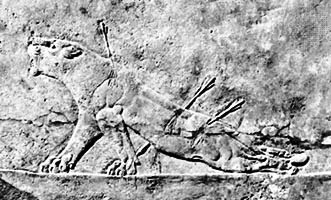
This is an alabaster Assyrian wall relief from Nineveh referred to as the Dying Lioness.  Alkholy describes it:  “It is a tragic scene full of energy and considered one of the earliest examples that represent emotional expression of pain.”  No doubt for twenty-first century viewers, who are aware of the need to protect our animal wild life, this is a disturbing image but pain is not an emotion.  It is a sensation and we can only correctly describe this relief as depicting a lion undergoing the sensation of pain.  No emotion is involved in the relief even if we anthropomorphize the lion.  I don’t think the artist anthropomorphized the lion but it is not unusual that some artist try to treat animals as if they were human.  Consider the painting below by Augustus Schenck.


This example is so obvious it is silly.  Here we have a sheep supposedly grieving over and protecting its dead lamb while a murder of crows, in the manner of Hitchcock’s The Birds, circle, waiting to pick over the remains. It is clearly a fantasy for any sheep rancher knows that sheep are the dumbest of animals (able to be herded by a rabbit (See http://www.youtube.com/watch?v=z9oPdqIqIns&feature=fvsr) and care little for their offspring once it has died.  Again, the artist is attempting to depict emotion, not express it.  No doubt some will view the image and exclaim: “Oh the poor mother.” projecting onto the sheep a human persona but there is no accounting for taste.

The idea that art should express emotion is an 18th century idea that has had its day.  Nevertheless there are still many around who believe that not only does art express emotion it is required to do it and they will find emotion in all works if only to spite the doubters.


This work is Picasso’s Weeping Woman but it is not at all clear what emotion it is supposed to depict.  People weep for many different reasons (Peeling onions for instance).  But then, again, some hold it is the viewer that describes the emotion and what the viewer says goes.  If you should be fortunate enough to view the actual painting you would be amazed at how bright and crisp the colors were.  It is not a large work but it is one of Picasso’s best.  The bright, crisp colors remind you that here is an artist who attends to technique and design.  It is difficult to become involved with the work on an emotional level because we are challenged to think of it in terms of the choices Picasso has made.  We marvel at his ability to give us a contorted image that is bright and cheery.  People who see this as merely a sad or sorrowful work miss the artist’s thought process that is the signature of his better works.  Perhaps this idea will be easier to understand if we compare this work to the work of another famous artist.    
Here is another colorful weeping woman by Roy Lichenstein.  What was it Alkholy  said?  Oh yes, “The expressiveness of figurative art moves the viewer, not only to admire the artist but to feel the expressed emotions themselves.”  Admittedly, some may not wish to call Lichtenstein’s work art but they would be an eccentric minority.  Alkholy’s statement was all inclusive.  I would be amazed to discover an arts patron who on viewing this work felt ‘the expressed emotions themselves’ but I suppose it would not be impossible that someone should identify with the situation this painting presents.  No doubt some works fill us with delight which can be described as an emotional reward.  Such a work for me was this small painting by Vermeer.


A photograph does not do the work justice.  It literally sparkles, drawing viewer into the work, forcing them to see what the artist saw.  We almost paint the work again following the line of color which exposes the artist’s technique.  Am I being too emotional here?

Launt Thompson
http://www.amazon.com/s/ref=nb_sb_noss?field-keywords=Launt+Thompson&url=search-alias%3Daps&x=16&y=9


[i]Inas Alkholy, Is the Reception of Emotional Expression in Visual Art Global? Pp3.


Thursday, March 1, 2012

Aesthetics Vs. Art

In 1735 the twenty one year old Alexander Baumgarten introduced to the art world the notion of the ‘aesthetic’ and proposed it to be a discipline that allowed the senses the priority place in the judgment of art.  Since that time all manner of books and essays have been written in an attempt to clarify and advance the ideas Baumgarten spawned. When a new field of knowledge evolves there is sure to be a ‘babble of disagreements’[i]among thoughtful scholars seeking to establish their credentials and aesthetics, as a result of its seeming adversity to rational thought, has provoked more than its fair share of scholarly angst.  

Aesthetics is said to be a discipline that seeks to explain how we may experience the ‘aesthetic object’ by taking up an ‘aesthetic attitude’ which is marked by a disinterested attention toward it.  In other words, we are only to consider that aspect of the object that moves us, all other considerations are pragmatic and inessential.  Though an aesthetic attitude is said to be a natural psychological phenomenon we must learn how to acquire or enhance it.  Initially aesthetics was concerned with ‘beauty’ and the many ways it was manifested in the aesthetic object but it was soon recognized that the term was too slippery for simple elucidation.  Attention shifted from what the aesthetic object was said to contain to what the viewer perceived in the object and how they described their perception. As perception is a subjective phenomenon the viewer was only required to point out what provoked their particular perception rather than demonstrate its objective validity.  

The problem is that a theory of aesthetics (or any theory for that matter) may be held reasonable only if it is true[ii] and theories that depend on subjective phenomena tend to defy truth tests.  Trevor Pateman reinforces the distinction between art and aesthetics:  “Aesthetic and artistic are different categories.  Aesthetic interest and relevance concern only what is available in the surface or structure of a work, even though in some cases that surface or structure may only be accessible to those with a quite definite knowledge.”[iii] This quite definite knowledge is thesural in scope for the landscape of adjectives and adverbs is the distinguishing tool of the aesthetician.  The aesthetician informs us of his perception of a work using terms like somber, graceful, garish (even gracefully garish), diminutive, flaccid, weakly, washed out, lanky, anaemic, wan and so forth.[iv]  Such terms are said to identify particular aesthetic qualities within a work.  Aestheticians defend the tendency to be verbose by hiding behind the mask of taste. 

But for some, aestheticians do not serve their discipline that well.  “Aesthetics fails to illuminate, often enough, because the aesthetician wants to retain “mystery”, rather than dispel it, to conceal his subject rather than to reveal it.  He wants to treat art instrumentally, as a “clue to reality”; his aesthetics is a spring-board to transcendental metaphysics.”[v]

Art critics and, in some instances, art historians borrowed generously from the vocabulary and practice of aestheticians to enhance their special disciplines.  It has come to pass that the critic who is most notable is usually the one who is most articulately verbose and maintains an eclectic vocabulary to capture the interest of his or her readers. Critics are, perhaps, the persons most responsible for passing on excerpts of aesthetic practice to the general public.  

For the most part, however, aesthetics is a practice that is much misunderstood and abused.  Carolyn Korsmeyer argues that “...philosophers will continue to be beset with theoretical difficulties concerning the concept of the aesthetic until a distinction is acknowledged between the aesthetic and the artistic.”[vi]   Korsmeyer’s concern is even more relevant when new developments in art are considered.  Conceptual art which is a reaction against notions of aesthetic experience and the role of perception provides no handle for the aesthetician to grasp.  Conceptual art is a major movement in the art world.  The 2001 winner of the prestigious Turner Prize was a work by Martin Creed titled The Lights Going On and Off. Creed merely used a bare room at the Tate and manipulated the lighting by a timer. 


Aesthetic practice displaced the need to discern the integrity of the form that contains the work of art but conceptual art reminds us that attending to form is a necessity.  Conceptual art is not merely a passing aberration.  Rather it is the child of Duchamp’s ready-mades; the evolution of an idea spawned by the Dada movement.  For conceptual artists the process of undertaking the work is their reward.  The work itself is little more than a grin without a cat.

The appreciation of works for their artistic achievement requires attention to objective criteria and is subject to truth tests which many members of the general public believe is a rigor that leaves them open to embarrassing  failure.  No such possibility exists in the practice of aesthetic appreciation.[vii]  The most that can be attributed to an inarticulate viewer is a lesser description of their experience.  To this end, aestheticians sought to promote a wider use of an aesthetic vocabulary which was believed to enhance the experience of viewers.  To be sure, aesthetics has had its detractors[viii] but it has, nevertheless, maintained a prominent position in discussions about art.

The answer to the question ‘What is Art?’ has proven to be even more illusive to scholars, academics and the general public than the question ‘What is Aesthetics?’, though artists tend to find no challenge in the former and dismiss the latter as outside of their domain.  For aestheticians a work of art is an aesthetic object that is man made but for many past and emerging artist works of art need be neither man made nor an aesthetic object.

For many there seems to be no unity of purpose among artists.  Artists are forever challenging accepted norms and so they should but it is not at all clear that artists always know what they are doing or always succeed at the artistic enterprise.  An artistic enterprise is that activity that results in a work of art but there is no specific or particular activity that guarantees a positive result.  There has yet to be proposed a universally accepted answer to the question ‘What is art?’ that sets out  definitive criteria that provide sufficient grounds for describing a work as a work of art.  This is particularly amazing when we realize that so many millions of art works have been produced and artists of all kinds seem to have little difficulty discerning between the failures and the successes of their fellow artists.  That this is so should lead us to suspect they are using criteria that they find difficult to express even should they have the unusual desire to do so.  After all, artists are doers, not theorists.

There are, of course, many different kinds of artists, some of whom use language as the medium of their artistic work.  For this type of artist theoretical musing is not a strange pastime.  Indeed, a number have entered the debate setting out their personal views.  Unfortunately they most often demonstrate a bias toward their own particular approach to art.  They seem to overlook the point that definitive criteria that provide sufficient grounds for describing a work as a work of art must be applicable to all the various art forms that have been and will be created.  For most artists and scholars devising such criteria is a fool’s enterprise. The problem, in part, comes about because the practice of aesthetics tend to fog the lenses of those seeking to find  all embracing criteria which may be used to describe our art forms and their works.

Universal acceptance for sufficient definitive criteria for works of art will never be possible until it is recognized that they have always been in the public domain but have seldom been delineated.  Such criteria are known to scholars as public criteria[ix] which are logically implicit in what we say and the way we behave.  The term ‘public’ means that such criteria are not hidden but open to discovery by anyone who cares to undertake the pursuit.  Be that as it may, ‘public criteria’ are not always matters of public agreement.  (There are still some among us who are prepared to accept as true the hypothesis that the world is flat.)  Rather, ‘public criteria’ establishes that the tests for truth are publicly determined.   It is important that we clarify the foundational concepts of art if we wish to both ‘see’ art and demonstrate how they strengthen our answer to the question ‘What is Art?’. 

Works of art invite us to read them.  We cannot think an artist spends his time and energy producing something he believes to be of worth so that we can choose what to concentrate on.   The playwright wants us to notice the script, the scenographer wants us to notice the set, the costume designer wants us to notice the costumes, the lighting designer wants us to notice the use of the lights, the actor wants us to notice the script’s interpretation, the director wants us to notice his or her treatment and staging.  Painters want us to notice the medium they are using, the pigments they have chosen and the techniques they have applied and in what light or environment it is presented to us.  They want us to appreciate the work in its entirety.
 
Unlike aesthetic appreciation, art appreciation requires that we attend to all aspects and parts of the work. Perhaps most important, art enthusiast  by analysis will quickly discover what it is they don’t know about a particular work and how to go about filling the gaps in their art knowledge.

Launt Thompson
http://www.amazon.com/s/ref=nb_sb_noss?field-keywords=Launt+Thompson&url=search-alias%3Daps&x=16&y=9


[i]See Sparshot, F.E. The Structure of Aesthetics’, University of Toronto Press, Toronto, 1963.
[ii]Sparshott, op. cit. pp13
[iii]Pateman, Trevor, Key Concepts A Guide to Aesthetics, Criticism and the Arts in Education, The Falmer Press, London, 1991. pp136.
[iv] See Sibley, Frank, Aesthetic Concepts, Philosophical Review, Vol. 68.1959
[v]Passmore, J.A., The Dreariness of Aesthetics, Mind, 1951.pp324.
[vi]Korsmeyer, Carolyn, On Distinguishing “Aesthetic” from “Artistic”, Journal of Aesthetic Education , 1977pp.46
[vii] “Hence aesthetic description need not have truth conditions in the strong sense, and to justify them may be to justify an experience and not a belief.” Scruton, Roger, Art and Imagination, Methuen & Co.Ltd., London 1974 pp55.
[viii]  See Passmore, J.A. “ The Dreariness of Aesthetics” in Mind 1951pp318 also in Elton, William, ed: Aesthetics and Language”, Blackwell, Oxford, 1954
[ix]See Wittgenstein, L., op. cit.